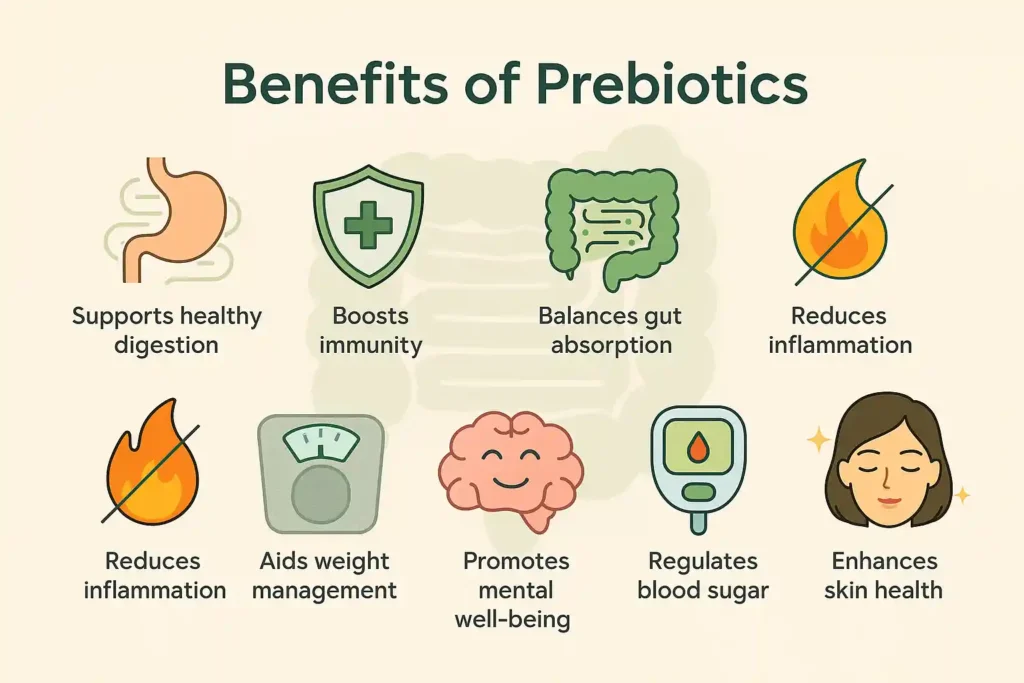
The prebiotics concept was introduced for the first time in 1995 by Glenn Gibson and Marcel Roberfroid [4]. Prebiotic was described as “a non-digestible food ingredient that beneficially affects the host by selectively stimulating the growth and/or activity of one or a limited number of bacteria in the colon, and thus improves host health”. This definition was almost unchanged for more than 15 years. According to this definition, only a few compounds of the carbohydrate group, such as short and long chain β-fructans [FOS and inulin], lactulose, and GOS, can be classified as prebiotics. In 2008, the 6th Meeting of the International Scientific Association of Probiotics and Prebiotics (ISAPP) defined “dietary prebiotics” as “a selectively fermented ingredient that results in specific changes in the composition and/or activity of the gastrointestinal microbiota, thus conferring benefit(s) upon host health” [19].
The following criteria are used to classify a compound as a prebiotic: (i) it should be resistant to acidic pH of stomach, cannot be hydrolyzed by mammalian enzymes, and also should not be absorbed in the gastrointestinal tract, (ii) it can be fermented by intestinal microbiota, and (iii) the growth and/or activity of the intestinal bacteria can be selectively stimulated by this compound and this process improves host’s health [19].
Although not all the prebiotics are carbohydrates, the following two criteria can be exploited to distinguish fiber from carbohydrate-derived prebiotics: (i) fibers are carbohydrates with a degree of polymerization (DP) equal or higher than 3 and (ii) endogenous enzymes in the small intestine cannot hydrolyze them. It should be taken into account that the fiber solubility or fermentability is not crucial [20,21].
There are also some revised definitions for prebiotics published in the scientific literature [22]. However, the above-mentioned definition, which was given in 2008, has been accepted in recent years. Despite the absence of a consensus definition, the important part of the original and other definitions is that the consumption of prebiotics is associated with human well-being. The word “selectivity”, or the potency of a prebiotic to stimulate a specific gut microbiota, was another key element of the original definition; however, this concept has been questioned recently [23]. In 2013, Scott et al. [24] reported that the prebiotic effect was enhanced by cross-feeding, defined as the product of one species which can be consumed by another one. This implication raises doubt for utilizing the “selectivity” term in the prebiotics definition. A review on the evolution of prebiotics concept through history can be found in a previous publication [23], and the debate on their definition is still ongoing [25].
3. Types of Prebiotics
There are many types of prebiotics. The majority of them are a subset of carbohydrate groups and are mostly oligosaccharide carbohydrates (OSCs). The relevant articles are mainly on OSCs, but there are also some pieces of evidence proving that prebiotics are not only carbohydrates.
3.1. Fructans
This category consists of inulin and fructo-oligosaccharide or oligofructose. Their structure is a linear chain of fructose with β(2→1) linkage. They usually have terminal glucose units with β(2→1) linkage. Inulin has DP of up to 60, while the DP of FOS is less than 10 [2].
Previously, some studies implicated that fructans can stimulate lactic acid bacteria selectively. However, over recent years, there are some investigations showing that the chain length of fructans is an important criterion to determine which bacteria can ferment them [26]. Therefore, other bacterial species can also be promoted directly or indirectly by fructans.